


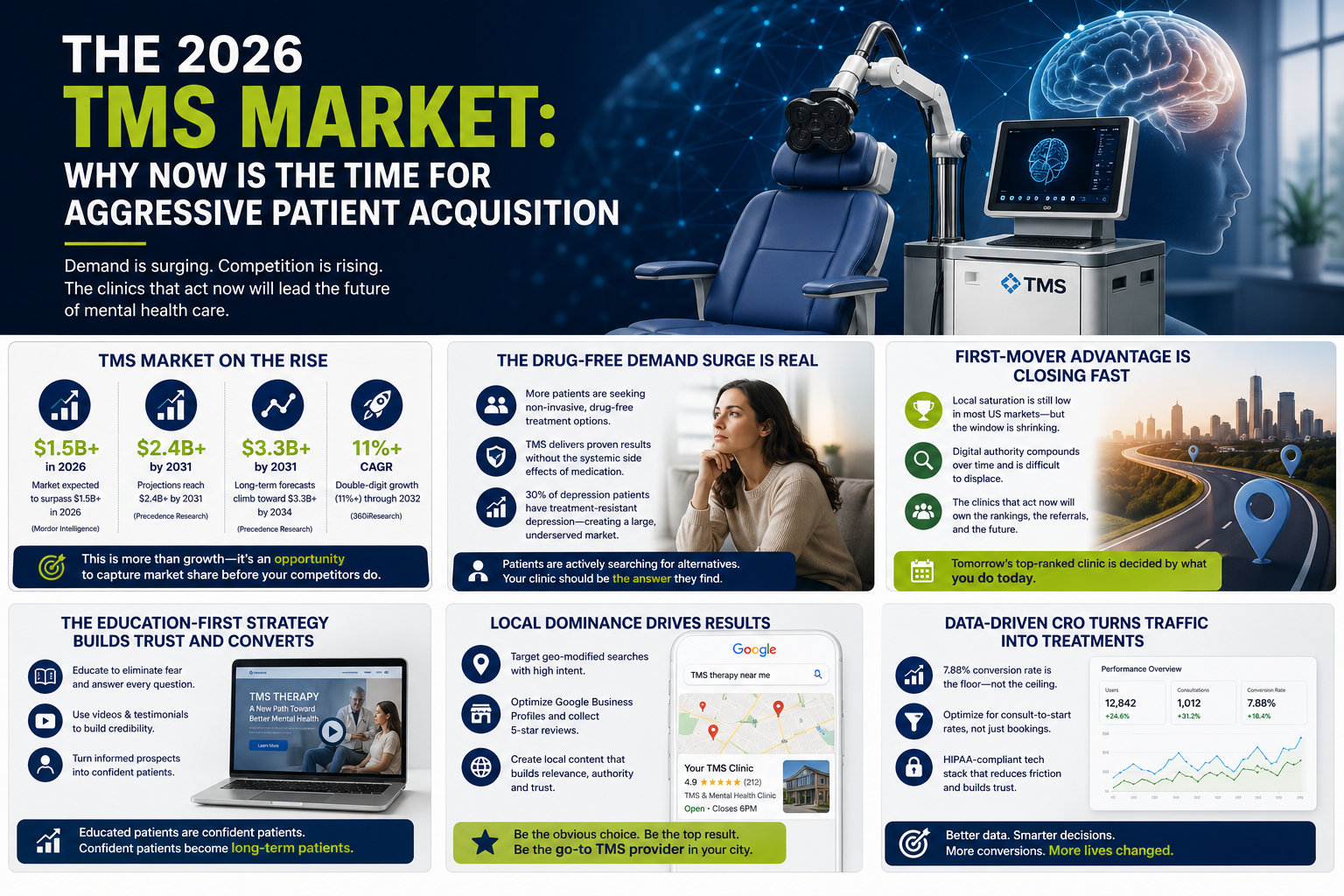
The 2026 TMS Market: Why Now is the Time for Aggressive Patient Acquisition
Mental health treatment is undergoing a fundamental shift — and clinics that recognize this moment will capture a decisive, lasting advantage. Transcranial magnetic stimulation (TMS) sits at the center of that shift, positioned as the most credible, evidence-backed alternative to pharmaceutical treatment for patients who have run out of options. For clinic owners thinking about marketing for TMS clinics, 2026 is not the year to wait — and partnering with a specialized healthcare digital agency rather than a generalist firm may be the single most consequential decision you make this year.
The Drug-Free Demand Surge Is Real
keting agencyPatient attitudes toward psychiatric medication have changed dramatically. A growing segment of people diagnosed with multiple conditions such as depression, OCD, and anxiety are actively seeking non-invasive, drug-free therapies — not as a last resort, but as a first preference. This cultural momentum is reinforced by clinical outcomes: TMS delivers measurable results without the systemic side effects associated with antidepressants, making it an increasingly attractive option for both patients and referring physicians.
The numbers reflect this demand. The global transcranial magnetic stimulator market is projected to expand significantly through 2033, driven by rising depression prevalence and growing insurance coverage. Treatment-resistant depression alone — defined as a condition that fails to respond to at least two antidepressant trials — affects an estimated 30% of all depression patients, creating a large and underserved population actively searching for solutions like TMS.
First-Mover Advantage Is Closing Fast
Local market saturation in TMS is still early in most US metro areas — but that window is narrowing. Clinics that establish digital authority now will be significantly harder to displace twelve months from now.
In competitive healthcare markets, brand visibility compounds over time. A clinic that invests in specialized healthcare SEO services today builds an asset that generates patient inquiries for years. One that delays cedes those rankings — and those patients — to competitors who moved first.
TMS as the Future of Psychiatric Care
Psychiatry is not moving backward toward polypharmacy. Major academic centers, payers, and patient advocacy groups are all increasing their focus on neuromodulation as a mainstream treatment pathway. TMS is no longer a niche offering — it is becoming a standard of care expectation for progressive mental health practices.
The opportunity is clear. The challenge is reaching the right patients, with the right message, before they find another clinic first. Understanding why conventional digital marketing consistently fails TMS providers is the essential next step.
Table of Contents
- The 2026 TMS Market: Why Now is the Time for Aggressive Patient Acquisition
- The Drug-Free Demand Surge Is Real
- First-Mover Advantage Is Closing Fast
- TMS as the Future of Psychiatric Care
- Why Generic Healthcare SEO Fails TMS Clinics
- The ‘Education Gap’: How Patients Actually Search
- Why Standard Keyword Targeting Misses High-Intent Patients
- The Terminology Problem With Generalist Agencies
- The ‘Education-First’ Patient Acquisition Strategy
- Demystifying the Treatment to Reduce Drop-Off
- Answering the Local Question: What Does Your City Actually Need?
- Video Testimonials and Clinical Explainers as Trust Infrastructure
- Local Dominance: Becoming the Go-To TMS Provider in Your City
- Targeting Local Search Intent
- Managing Google Business Profiles for Multi-Location Clinics
- Local Content and Geographic Expansion
- Data-Driven Performance: CRO for Neuromodulation
- 7.88% Is the Floor, Not the Finish Line
- Landing Pages Built Around ‘Consult-to-Start’ Rates
- The Technical Stack: Integration and HIPAA Compliance
- Reducing Friction in the Booking Journey
- Choosing the Right Partner: What to Look for in a TMS Agency
- Neuromodulation Experience Isn’t Optional
- The AET Framework as a Qualifying Standard
Why Generic Healthcare SEO Fails TMS Clinics
The 2026 TMS market opportunity is real — but capturing it requires a fundamentally different approach than standard healthcare marketing. The core problem is a disconnect that most clinics, and virtually every generalist healthcare digital agency, fail to address: the patients you want to reach aren’t searching the way you think they are.
The ‘Education Gap’: How Patients Actually Search
The Education Gap: The disconnect between the clinical language TMS providers use and the everyday language patients use when searching for relief — a gap that causes high-intent patients to never find your practice.
Patients suffering from treatment-resistant depression aren’t typing “TMS therapy near me” into Google. They’re searching for “why do antidepressants stop working,” “depression treatment without medication,” or “alternatives to SSRIs.” They’re in pain, not conducting clinical research. Standard keyword strategies built around procedure-specific terms like “transcranial magnetic stimulation” or “neuromodulation clinic” target a patient who already knows TMS exists — a much smaller, further-down-the-funnel audience.
The practical implication is significant: clinics optimizing exclusively for clinical terminology are competing loudly in a quiet room while the actual patient conversation is happening somewhere else entirely.
Why Standard Keyword Targeting Misses High-Intent Patients
High-intent patients — those actively seeking a solution and ready to book a consultation — are searching with emotional and symptomatic language, not diagnostic terminology. A generic SEO strategy maps keywords to services one-to-one. TMS marketing requires a three-layer approach:
- Symptom-layer keywords (“can’t feel happy,” “depression not responding to medication”)
- Solution-exploration keywords (“drug-free depression treatment,” “brain stimulation therapy”)
- Procedure-validation keywords (“is TMS therapy safe,” “does TMS work for depression”)
Each layer represents a different stage of patient awareness. Missing the first two means your clinic is invisible to the majority of your addressable market.
The Terminology Problem With Generalist Agencies
Neuromodulation terminology — the precise clinical language covering everything from repetitive TMS protocols to theta burst stimulation parameters — isn’t something a generalist agency learns in an onboarding call. Misused terminology erodes trust with both patients and search algorithms. Google’s E-E-A-T framework (Experience, Expertise, Authoritativeness, Trustworthiness) rewards clinically accurate, deeply contextual content — and penalizes the shallow, repurposed copy that generalist teams typically produce for specialty medical services.
Trust, critically, must be earned before the first click. A patient scanning search results is already making judgments based on your meta description, your headline language, and how clinically credible your snippet sounds. That first impression is either built or lost in under three seconds.
The solution isn’t simply better keywords — it’s a content and positioning architecture designed around how patients actually think and feel. That’s exactly where an education-first acquisition strategy becomes the highest-leverage growth tool available to a TMS clinic today.
The ‘Education-First’ Patient Acquisition Strategy
Most TMS clinics lose prospective patients long before a consultation is ever scheduled. The reason isn’t price. It isn’t location. It’s fear — specifically, the anxiety that comes from not understanding what TMS therapy actually involves. An education-first patient acquisition strategy addresses this directly: it uses structured, accessible content to answer every question a hesitant patient is silently asking before they ever pick up the phone.
This approach is the practical foundation of effective SEO for medical practices operating in high-consideration, high-anxiety treatment categories. TMS isn’t like booking a teeth cleaning. Prospective patients are often managing years of treatment-resistant depression, weighing unfamiliar technology, and navigating insurance uncertainty — all at once. Content that educates rather than just promotes removes the friction between curiosity and commitment.
Demystifying the Treatment to Reduce Drop-Off
The patient journey for TMS typically spans four to six weeks of daily sessions. That’s a significant commitment, and most prospects who don’t convert are abandoning the process at the research stage — not because they don’t want relief, but because the process feels opaque.
Patient education content: Clinically accurate, accessible materials — articles, videos, FAQs — designed to move a prospective patient from uninformed to confident enough to schedule.
Effective education content covers the basics — what a session feels like, what the coil does, why multiple sessions are required — but it also anticipates emotional objections. Pages that explain “why TMS is different from ECT” or “what happens if I skip a session” consistently outperform generic landing pages because they mirror the exact language patients use when searching.
Answering the Local Question: What Does Your City Actually Need?
Generic mental health content doesn’t build authority at the market level. What works is content built around a specific question: What does our city need from a mental health practice?
This means understanding the demographic texture of your service area. Are anxiety disorders more prevalent than major depressive disorder in your metro? Is there a gap in coverage for postpartum depression treatment? Are there underserved ZIP codes where awareness of non-medication options is particularly low? Answering these questions through targeted content — not just clinical explainers, but community-relevant mental health resources — signals both relevance and authority to search engines and prospective patients alike.
Video Testimonials and Clinical Explainers as Trust Infrastructure
Video testimonials are among the highest-converting assets a TMS clinic can deploy. A two-minute first-person account from a patient who completed a full course of treatment addresses skepticism in a way that no written case study can replicate. Pair that with short-form clinical explainers — a psychiatrist walking viewers through the neuroscience of repetitive TMS in plain language — and you’ve built a trust ecosystem that works around the clock.
Clinics that implement this combination consistently see measurable results. A realistic growth trajectory for a single-location practice executing this strategy is moving from approximately 14 new consultations per month to 32 — roughly doubling volume without adding headcount or paid advertising spend at a proportional rate.
The education-first model creates a compounding asset: every piece of content extends your clinic’s reach. But reach is only as valuable as the geographic market it captures — which is why dominating your local search presence is the essential next step.
Local Dominance: Becoming the Go-To TMS Provider in Your City
The education-first content strategy covered earlier builds trust — but trust only converts when patients can actually find your clinic. That’s where local search dominance becomes the linchpin of every successful patient acquisition strategy for TMS providers. Ranking nationally for “TMS therapy” is a long game with steep competition. Owning your city? That’s achievable, measurable, and directly tied to revenue.
Targeting Local Search Intent
Consider how a prospective patient actually searches. They don’t type “transcranial magnetic stimulation.” They type “Fort Worth TMS” or “TMS therapy near me” or “depression treatment Dallas no medication.” These geo-modified queries — search terms that combine a treatment or condition with a specific city, neighborhood, or zip code — carry significantly higher purchase intent than broad informational searches.
Optimizing for these terms requires more than dropping a city name into a page title. It means building location-specific landing pages with original content, locally relevant testimonials, and schema markup that signals geographic relevance to Google. Each city or service area your clinic serves should have its own dedicated page — not a duplicate with a swapped city name, but a genuinely distinct resource that reflects the local mental health landscape.
Geo-modified query: A search term that pairs a treatment, service, or condition with a specific geographic identifier (city, neighborhood, zip code), indicating that the user is looking for a local provider rather than general information.
Managing Google Business Profiles for Multi-Location Clinics
For clinics operating across multiple locations, Google Business Profile (GBP) optimization is non-negotiable. Each physical location should have its own fully completed GBP listing — accurate hours, services listed explicitly (including TMS and any specific devices used), and a consistent stream of patient reviews. Inconsistent NAP data (name, address, phone number) across directories is one of the fastest ways to lose local pack rankings.
Review management matters as much as profile completeness. A clinic with 4.8 stars and 200 reviews signals credibility to both Google and prospective patients who are already anxious about trying a new treatment. Responding to every review — positive or critical — demonstrates the kind of attentiveness that mental health patients specifically look for in a provider.
Local Content and Geographic Expansion
Building community trust through local-specific mental health content accelerates authority in ways that generic clinical information cannot. Blog posts addressing regional topics — mental health statistics in your state, partnerships with local psychiatrists, community events — create genuine relevance signals.
There’s also a compelling financial argument for geographic expansion. As a clinic adds service-area pages and earns local authority across multiple markets, the cost-per-conversion typically decreases because organic traffic scales without proportional ad spend increases. A multi-location clinic that owns local search in three cities doesn’t triple its marketing costs — it spreads fixed content investment across higher patient volume.
Of course, attracting patients to your site is only half the equation. Once they arrive, converting that traffic into booked consultations requires a disciplined approach to page performance and user experience — which is exactly where data-driven optimization takes over.
Data-Driven Performance: CRO for Neuromodulation
Building local authority and educating prospective patients gets them to your door — but conversion rate optimization (CRO) determines how many of them actually walk through it. For TMS clinics, CRO isn’t a website tweak. It’s a systematic process of measuring and improving every touchpoint between a curious visitor and a seated patient.
Conversion Rate Optimization (CRO): The practice of increasing the percentage of website visitors or leads who take a desired action — in a clinical context, that means booking a consultation, completing intake forms, or starting treatment.
7.88% Is the Floor, Not the Finish Line
A well-executed TMS landing page from a seasoned medical SEO agency should be clearing a 7.88% conversion rate as its baseline. That number represents what’s achievable with solid copy, clean design, and basic trust signals in place. The clinics scaling efficiently treat that as the starting point for optimization — not the goal. Through iterative A/B testing of headlines, call-to-action placement, and social proof elements, leading TMS practices push conversion rates significantly higher, translating directly into lower cost-per-acquisition and stronger monthly patient volume.
Landing Pages Built Around ‘Consult-to-Start’ Rates
Most clinics fixate on consultation bookings. Smart clinics track the full funnel — particularly the consult-to-start rate, which measures how many patients who attend an initial consultation actually begin a treatment course. A high consultation volume with a poor consult-to-start rate signals a disconnect: either the wrong patients are being attracted, or something in the consultation experience is breaking down. Optimized landing pages address this upstream by pre-qualifying visitors with educational copy, realistic outcome framing, and transparent insurance information — so that patients who book are already primed to proceed.
The Technical Stack: Integration and HIPAA Compliance
CRO in neuromodulation requires more than design instincts. The technical infrastructure matters significantly. A properly configured clinic stack typically includes:
- TMS practice management software with scheduling capabilities
- A CRM system that tracks leads from first click through treatment completion
- HIPAA-compliant forms and data storage — non-negotiable for any patient-facing digital touchpoint
- Automated follow-up sequences for leads who didn’t book on first contact
Each layer of this stack creates data that feeds smarter optimization decisions. Without it, you’re guessing.
Reducing Friction in the Booking Journey
Friction — any unnecessary step, moment of confusion, or delay between intent and action — is the silent killer of patient acquisition. In practice, friction looks like a phone-only booking system, a 10-field intake form, or a landing page that buries the consultation CTA below multiple paragraphs of clinical text. Reducing friction means making it effortless for a motivated patient to say yes.
The clinics achieving the strongest growth combine this technical rigor with experienced strategic oversight — which raises an important question: how do you identify the right partner to build and manage this entire system for you?
Choosing the Right Partner: What to Look for in a TMS Agency
Scaling a neuromodulation clinic isn’t just about reaching more people — it’s about reaching the right people at the right moment in their treatment journey. The strategies covered throughout this guide — local SEO dominance, education-first content, and data-driven CRO — only deliver results when executed by a partner who truly understands the neuromodulation space. Choosing generic TMS marketing services from a broad healthcare agency is one of the most common and costly mistakes clinic owners make.
Neuromodulation Experience Isn’t Optional
General healthcare marketing knowledge doesn’t translate to TMS growth. The clinical nuances of patient eligibility, insurance authorization timelines, and the emotional weight of depression treatment require a partner who has navigated these realities before. Look specifically for agencies with demonstrable experience in billing and credentialing workflows — the Metro NeuroHealth model demonstrates how deeply operational knowledge and marketing strategy must intertwine. A missed prior-authorization touchpoint in a nurture sequence can stall a conversion that took months of trust-building to earn.
Proven track record: Look for case studies, measurable outcomes, and references specific to neuromodulation — not just “mental health” or “behavioral health” broadly defined.
The global TMS therapy market is expanding rapidly, and competition for qualified patients is intensifying alongside it. An agency that built its credentials on orthopedics or aesthetics is ill-equipped to compete in this environment.
The AET Framework as a Qualifying Standard
The best agencies organize their entire growth methodology around AET — Awareness, Education, Trust. This framework acknowledges that TMS patients don’t convert on impulse; they move through a structured belief-building process before committing to a treatment plan. Any agency that leads with ad spend before establishing educational infrastructure is working backward.
When evaluating a growth partner, ask these questions directly:
- How do you handle HIPAA compliance across paid campaigns and landing pages?
- What’s your typical time-to-conversion for TMS patients from first touch?
- How do you integrate organic and paid channels to support the full patient journey?
- What reporting frameworks do you use to connect marketing activity to booked appointments?
The right partner will answer these questions confidently — because they’ve solved them before.
A specialized growth partner isn’t a vendor — they’re the operational backbone that turns clinical excellence into sustainable patient volume. If 2026 is the year your clinic commits to scaling, that commitment starts with choosing a partner who speaks your language.
Key Takeaways
- The 2026 TMS Market: Why Now is the Time for Aggressive Patient Acquisition
- Why Generic Healthcare SEO Fails TMS Clinics
- The ‘Education-First’ Patient Acquisition Strategy
- Local Dominance: Becoming the Go-To TMS Provider in Your City
- Data-Driven Performance: CRO for Neuromodulation